
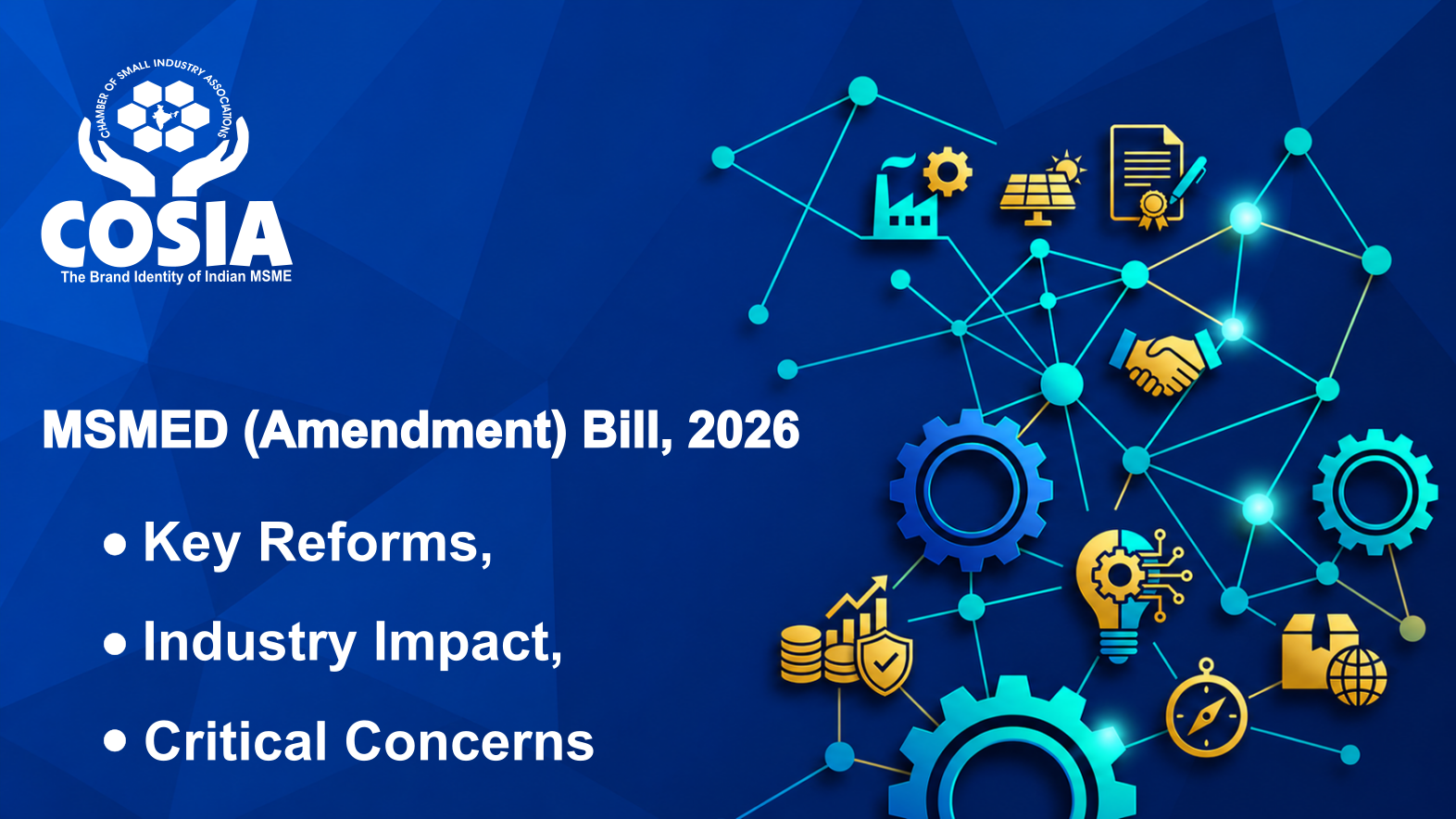
The Parliament has officially passed the Micro, Small and Medium Enterprises Development (Amendment) Bill, 2026. Introduced in the Rajya Sabha on July 28, 2026, the Bill was passed by the Upper House on August 3, 2026, and subsequently passed by the Lok Sabha on August 7, 2026. It now awaits Presidential assent to become law.
As the Chamber of Small Industry Associations (COSIA), representing micro and small enterprises across the industrial landscape, we have analyzed the provisions of the amended legislation. While the Bill introduces long-awaited statutory backing to classification criteria and stricter timelines for delayed payment dispute resolution, specific operational and procedural loopholes require urgent attention to prevent unintended burden on MSEs.
1. Updated Definition and Classification Criteria (Section 7)
The 2026 Amendment replaces the original investment-only thresholds (from the 2006 Act) with statutory recognition of the composite criteria (combining Investment in Plant & Machinery/Equipment AND Annual Turnover).
The latest revised classification criteria applicable across both Manufacturing and Service sectors remain as follows:
Micro Enterprise
- Investment in Plant & Machinery / Equipment: Not exceeding ₹2.5 Crore
- Annual Turnover (Excluding Exports): Not exceeding ₹10 Crore
Small Enterprise
- Investment in Plant & Machinery / Equipment: Not exceeding ₹25 Crore
- Annual Turnover (Excluding Exports): Not exceeding ₹100 Crore
Medium Enterprise
- Investment in Plant & Machinery / Equipment: Not exceeding ₹125 Crore
- Annual Turnover (Excluding Exports): Not exceeding ₹500 Crore
Note: As provided in Explanation 1 to Section 7(1), cost of pollution control, research & development, and industrial safety devices continue to be excluded when computing investment figures.
2. Key Positive Highlights of the Amendment Bill
A. Mandatory TReDS Settlement for CPSEs (Section 15A & Section 22A)
Every Central Public Sector Enterprise (CPSE) is now legally mandated to route invoice settlements through a Reserve Bank-authorized Trade Receivables Discounting System (TReDS) platform for goods and services procured from MSMEs. This will unlock liquidity and shorten payment realization cycles for small suppliers.
B. Strict Timelines for Dispute Resolution (Section 18)
To curb procedural stalling by large buyers:
- Mediation Window: Mediation before the MSE Facilitation Council (MSEFC) or mediation service provider must be completed within 90 days from the date fixed for first appearance.
- Arbitration Referral: If mediation fails, reference to arbitration must be made within 30 days.
- Arbitral Award: The tribunal or Council must pronounce the arbitral award within 90 days from the completion of pleadings.
C. Enhanced Protection During Appeals (Section 19)
The 75% pre-deposit requirement for buyers seeking to set aside an award or mediated settlement agreement remains mandatory. Furthermore, if an application to set aside an award remains pending in court for more than six months, the court is now mandated to release at least 50% of the deposited amount to the MSE supplier immediately.
D. Recovery as Arrears of Land Revenue (Section 18A)
Awards and mediated settlement agreements can now be directly recovered as an arrear of land revenue by the State Government through District Collectors/Deputy Commissioners where buyer assets are located, and are recognized as legally enforceable debt under the Insolvency and Bankruptcy Code (IBC), 2016.
E. Rationalized Composition and Expansion of Councils (Section 20 & 21)
State Governments are directed to set up an adequate number of MSEFCs with dedicated infrastructure, digital systems, and trained manpower. Council composition now explicitly includes an officer not below Joint Director rank as Chairperson, industry association representatives, and at least one member from the legal field.
3. Critical Concerns Identified by COSIA
While the overarching objective of the Bill to ease doing business and expedite payment recovery is commendable, COSIA highlights two critical concerns that threaten to undercut these gains for ground-level MSE suppliers:
Concern 1: Risk of Registration Duplication & State-Level Bureaucracy (Section 8)
- The Provision: Section 8(1) introduces a national digital platform for free and voluntary registration (Udyam). However, Section 8(2) empowers State Governments to notify separate State digital portals for registration to grant State-specific scheme benefits.
- COSIA’s View: Empowering State Governments to establish separate registration procedures and portals creates unnecessary duplication of compliance. There is a serious risk that State-level portals could be misused to delay or deny state benefits, creating extra administrative hurdles and potential harassment for small enterprises seeking incentives. A single, unified national portal with seamless back-end integration for State benefits is the only logical way forward.
Concern 2: External Mediation Costs & Delay Tactics (Section 18)
- The Provision: Amended Section 18 permits referring payment disputes to external mediation service providers or alternative dispute resolution (ADR) institutions.
- COSIA’s View: Outsources/external mediation channels pose significant cost implications for aggrieved Micro and Small Sellers who are already constrained by cash flows. Large corporate buyers with superior legal resources can exploit external mediation proceedings to stall payments and drag out litigation, turning what should be a summary recovery tool into a costly delay tactic against vulnerable suppliers.
Way Forward
COSIA urges the Ministry of MSME and State Governments to issue clear administrative guidelines under the delegated rule-making provisions (Sections 29 and 30):
- Ensure State Governments adopt Udyam single-window data sharing rather than forcing MSMEs to re-register on independent State portals under Section 8(2).
- Cap mediation costs and fix strict, unextendable hearings for external mediation under Section 18 to ensure large buyers cannot weaponize ADR mechanisms against small suppliers