
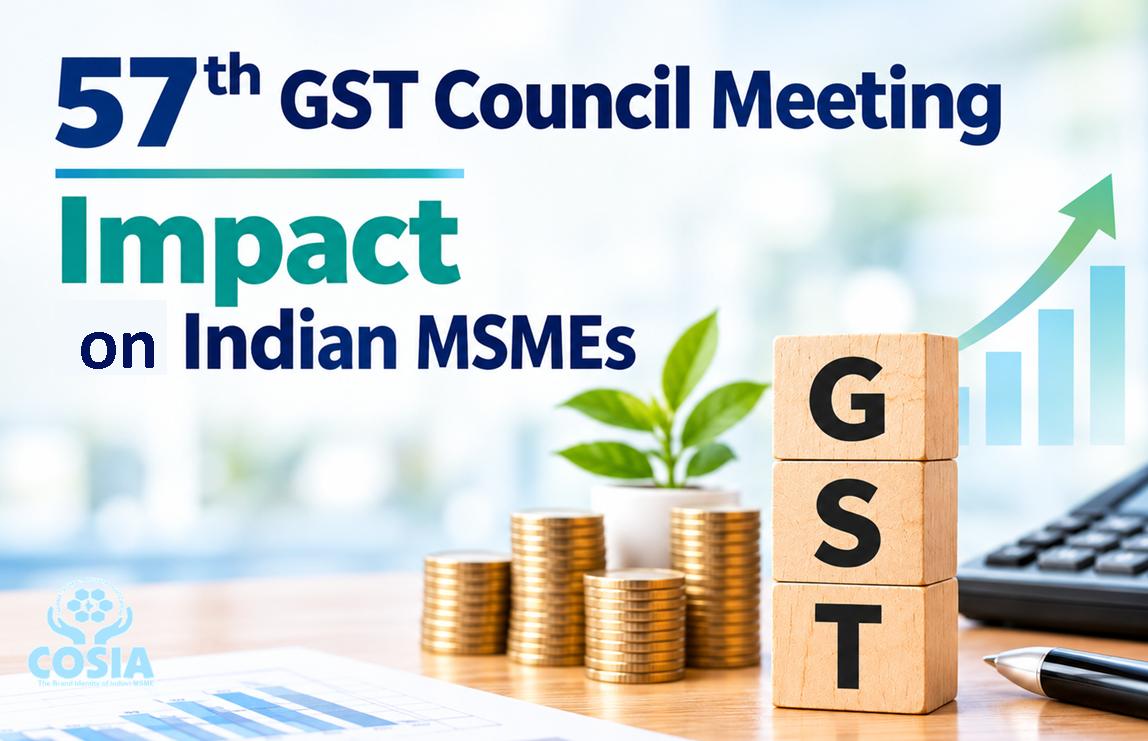
The 57th GST Council meeting held on 8th October 2026 has recommended several reforms that could directly benefit micro, small and medium enterprises (MSMEs), particularly in GST litigation, input tax credit (ITC), working capital, compliance costs and expansion through e-commerce.
Unlike the 56th meeting, which focused substantially on GST rate rationalisation, the 57th meeting focused on simplifying GST administration and reducing procedural difficulties for businesses. The recommendations were announced by the Ministry of Finance on 8 October 2026.
The most important point for MSMEs is that these are Council recommendations, not necessarily immediately enforceable changes. The applicable notifications, circulars and statutory amendments must be examined before businesses change their compliance practices.
A. Major recommendations and their impact on MSMEs
1. Removal of arrest provisions under GST
Major relief: The Council has recommended omitting Section 69 of the CGST Act, which provides for arrest in specified GST offences.
Impact: Reduces the risk of arrest-related coercive action for MSME owners and directors in GST matters. However, this does not eliminate tax investigations, demands, penalties or prosecution under the revised framework.
2. Prosecution threshold increased from ₹1 crore to ₹5 crore
Impact: Smaller tax disputes may be less likely to result in criminal prosecution under the proposed threshold. The threshold change is not a general waiver of tax liability, interest or civil penalties, and the treatment of different offences must be checked under the amended provisions.
3. General penalty reduced from ₹25,000 to ₹10,000
Impact: Lowers the maximum general penalty under Section 125, where that provision applies. This can reduce the cost of certain compliance-related defaults, but it does not automatically reduce penalties under every GST provision.
4. Minimum threshold of ₹10,000 for GST show-cause notices
Impact: The Council has recommended that notices under Sections 73, 74 and 74A not be issued where the total tax amount involved is below ₹10,000. The recommendation also addresses certain pending small-value matters once the provision takes effect.
5. Faster GST refunds and improved working capital
The proposed system includes automatic refunds of excess electronic cash ledger balances and provisional sanction of 90% of eligible zero-rated supply and inverted-duty-structure refunds, subject to system-based risk assessment.
Impact: Export-oriented manufacturers and MSMEs accumulating input tax credit may see less money blocked in the GST system, potentially reducing their working-capital borrowing requirements.
6. Wider eligibility for input tax credit
The Council has recommended removing certain blocked-ITC restrictions, including those relating to specified health and life insurance, outdoor catering, certain telecom towers and external pipelines, free samples, and goods destroyed or written off on expiry of shelf life.
Impact: Eligible MSMEs may be able to reduce embedded GST costs on specified business expenses. The actual benefit depends on the final amendments, the nature of the expenditure and the applicable conditions.
7. Easier interstate e-commerce sales
Small sellers of goods may be able to register in another State using an e-commerce operator’s warehouse as their principal place of business, subject to prescribed conditions, including the monthly ITC pass-through limit of ₹2.5 lakh.
Impact: A small manufacturer or trader could expand into new States through an e-commerce platform without establishing a separate physical business location in every State.
8. Reduced disruption during transportation of goods
Interception is proposed to be restricted to cases involving specific intelligence and authorisation by an officer of at least Joint Commissioner rank. The proposed changes also restrict action in transit States, subject to exceptions.
Impact: Manufacturers and logistics-dependent MSMEs could face fewer arbitrary transit interruptions, reducing delivery delays and associated costs.
9. Late-fee relief for smaller taxpayers
The Council has recommended waiving late fees for delayed returns under Section 39(1) for taxpayers whose preceding financial year’s turnover was up to ₹5 crore, provided the delayed return is filed by the end of its due month.
Impact: Offers a limited compliance-cost benefit to eligible MSMEs that miss a return deadline but file within the specified extended window.
10. Optional annual-return, quarterly-payment scheme
The Council has approved in principle a proposed Annual Return Quarterly Payment (ARQP) scheme for eligible taxpayers with turnover up to ₹5 crore who supply exclusively to unregistered customers (B2C).
Impact: Could reduce routine compliance and payment frequency for eligible consumer-facing small businesses. It is not a blanket scheme for all MSMEs, particularly B2B suppliers.
The above recommendations are based on the Ministry of Finance’s official release.
B. Additional reforms relevant to manufacturing MSMEs
| Recommendation | Practical impact |
| Refund of ITC on input services under inverted duty structure | Proposed for eligible credit on input services availed from 1 November 2026. |
| Refund of ITC on capital goods | Proposed for eligible zero-rated supplies and inverted-duty cases for credit on capital goods availed from 1 April 2027, spread over 60 months. |
| Better ITC reconciliation and correction of returns | Proposed changes to GSTR-1, GSTR-1A, GSTR-3B and the Invoice Management System aim to reduce mismatches and related notices. The revised mechanism is recommended from the April 2027 return period. |
| Opportunity to object to blocked electronic credit | A proposed amendment to Rule 86A would let taxpayers object to credit blocking and seek a personal hearing before a decision on the objection. |
| Standardised notices and adjudication | Common guidance on demand notices, fraud allegations, personal hearings and reasoned orders could improve consistency in GST proceedings. |
These measures could be particularly relevant to manufacturing units with substantial capital investment, accumulated input credit, multiple suppliers and recurring reconciliation issues.
C. What should MSME associations prioritize?
For organisations representing MSMEs, including manufacturing and industrial associations, the following issues merit close monitoring.
- Protection of genuine buyers claiming ITC
Seek clear safeguards against denial of credit to genuine purchasers solely because a supplier defaults, where the buyer has complied with applicable legal requirements. The 57th meeting’s broader ITC reforms do not, by themselves, settle every supplier-default dispute.
- Effective refund timelines
Monitor whether automatic refund processing actually reduces delays and whether risk-based verification causes prolonged withholding of otherwise eligible claims.
- Predictable enforcement
Seek uniform implementation of the proposed safeguards relating to arrest, prosecution, e-way bill interception, ITC blocking and personal hearings.
- Simpler compliance for small manufacturers
Push for fewer repetitive filings, practical correction windows, proportionate penalties and a straightforward system for correcting genuine errors without unnecessary litigation.
D. What should MSMEs do immediately?
- Continue filing returns and paying tax under the existing applicable law until the relevant changes take effect.
- Reconcile GSTR-2B with purchase records and follow up with suppliers for missing invoices.
- Review pending refund claims and maintain supporting documentation.
- Retain invoices, e-way bills, transport documents and evidence of genuine transactions.
- Ask the tax adviser to identify which proposed changes could apply to ongoing assessments, appeals or refund applications.
Overall assessment
The 57th GST Council meeting’s recommendations could benefit MSMEs through reduced enforcement risk, lower exposure to certain penalties, improved access to refunds, potentially wider ITC eligibility and simpler interstate business expansion.
However, the benefits will vary. A domestic B2B manufacturing unit may gain more from ITC and enforcement reforms, while an exporter may benefit more from refund measures. A small B2C enterprise could benefit from the proposed quarterly-payment scheme.
Important distinction: the recommendations do not automatically cancel existing GST demands, validate disputed ITC claims, eliminate interest liabilities or guarantee immediate refunds. Their practical impact will depend on the final legal changes and how consistently they are implemented.
Source: Official Ministry of Finance release — Recommendations of the 57th GST Council Meeting.